Stock Film
1. Selected and discarded footage
2. Rough cut
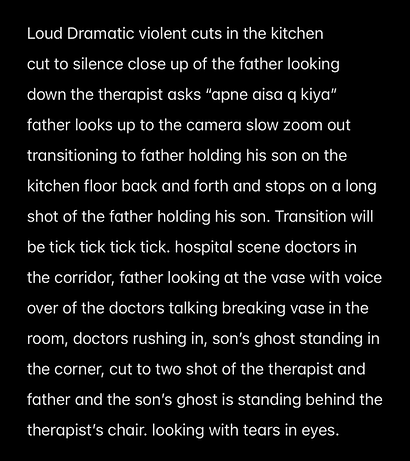
After first editing with the help of everything I had dumped in my notes app (due to my goldfish memory) and for my own sanity and peace. Later according to the shot list and some improvisation. I successfully was able to edit our film opening in two sittings at cbtl with my friends, and one at Filza's.

After trying out the most obnoxious sound effects on capcut, rethinking every sequence, and countless vanilla lattes, this is what the rough cut for our film opening looks like:
After assembling the sequences in order, I felt that the hospital scene lacked substance and refinement compared to the rest of the opening. Due to rushed planning and execution, it didn’t integrate as effectively, which made the overall opening feel less satisfying. In contrast, the opening sequence itself felt strong and played a key role in holding the film together.
3. Dialogue problems
The dialogues for our film opening were probably the most complex part of writing the script. Writing our dialogues in Urdu wasn’t easy, as neither of us is proficient in the language. First, Filza and I vaguely wrote our dialogues in the script. Second, we had our actors improvise during the shoot. Third, I chose the scenes with the dialogues I liked the most. We had the advantage of not having an abundance of dialogue in our film opening; it was visually pretty self-explanatory. However, the doctor’s conversation and the one with the therapist were the most essential for our film. These two scenes explain the plot to the audience, making it easier to understand. Initially, we translated the dialogues for these two scenes from English to Urdu with the help of Filza’s sister. We put ourselves in a therapist’s position: what would a therapist ask a father who has brutally murdered his own son? How would the father phrase his response? How would two doctors converse about such a patient?
Our first guesses, as mentioned above in the screenshot of my notes app, were: “aapne aisa kya kiya,” which we changed to “aapne usko kya maara?” as this slight change would perhaps make it clearer to the audience that the first sequence wasn’t a dream or hallucination -- he is a murderer. The father’s response that we agreed upon was, “maine usko maara nahi, bachaya hai,” as, in his head, due to his mental illness, he assumes he protected his son from something evil -- “freed him.” For the doctor’s conversation, we decided on the spot to disclose how long the patient had been in the hospital for and what exactly his response was when interrogated.
4. Suggested changes
We showed our film opening to our friends, seniors, family members, and, of course, our media studies teacher, Sir Zia. Everyone, along with Sir Zia, was pleased with our film opening and applauded it. Although, the changes Sir Zia suggested for us to make were:
-
The music was too loud.
-
The beginning looked more like a music video and less like a film opening.
However, these changes were optional, and since we had already finalised our film opening, we were, for once, satisfied with our work.
One change that I did make, upon Filza’s suggestion, was while curating the title animation for our film opening.
I changed it from this: To this:


5. Final Cut
First, I inserted a shot during the doctor’s conversation about the patient to give the audience a visual understanding of the people behind the voiceover dressed as doctors, I integrated the opening credits and animated title into the end of the film opening. included our animated production logo at the beginning and slightly refined the editing.
Second, I sent our final film opening to Sir Zia for him to review it once and for all.
Third, I present to you the final cut for our film opening “Bound by evil”:

6. Editing reflection
As a trusted media enthusiast and creative director, I never imagined a media project would take such a toll on me. But our preliminary really did as I had never edited a film with a genre such as “crime comedy” before. I sat in front of my laptop, scrolling through YouTube videos on “how to edit a crime comedy” and rethinking all my decisions. Our film opening comparatively didn’t need a lot of “how to edit this” research from me. As I’ve done multiple media projects for people in my circle, with their film genres ranging from psychological thrillers to horror. After our film opening, Sir Zia did warn us, saying, “You’re going to have to do better than this for your film opening.” Filza and I nodded to each other with big, confident smiles on our faces, like we could conquer anything and everything. When I first sat down to edit with the selected footage, I searched for a good background audio for the opening sequence like my life depended on it, for hours on end. Nothing seemed to fit perfectly. Thankfully, I finish what I start, so quitting is never an option. After finding a background audio that seemed to fit well, I strictly followed the shot list we put all of our brain cells into, I didn’t want any new ideas distracting me from the original plan. I was surprisingly satisfied with how it was turning out, everything aligned just how I wanted and imagined it to. Learning from my past mistakes: having multiple different transition shots and takes came in handy for the opening sequence – fast cuts couldn't have repetitive shots. The therapy and hospital sequence worked perfectly, explaining the plot to the audience. After getting done with the one thing I was the most conflicted about -- the opening sequence. The rest of the editing process became a lot easier for me. I made 4-5 drafts in 24 hours, risking my fingers, and breaking my back. Overall, the editing of our film opening left exactly the impact on viewers that I intended.